
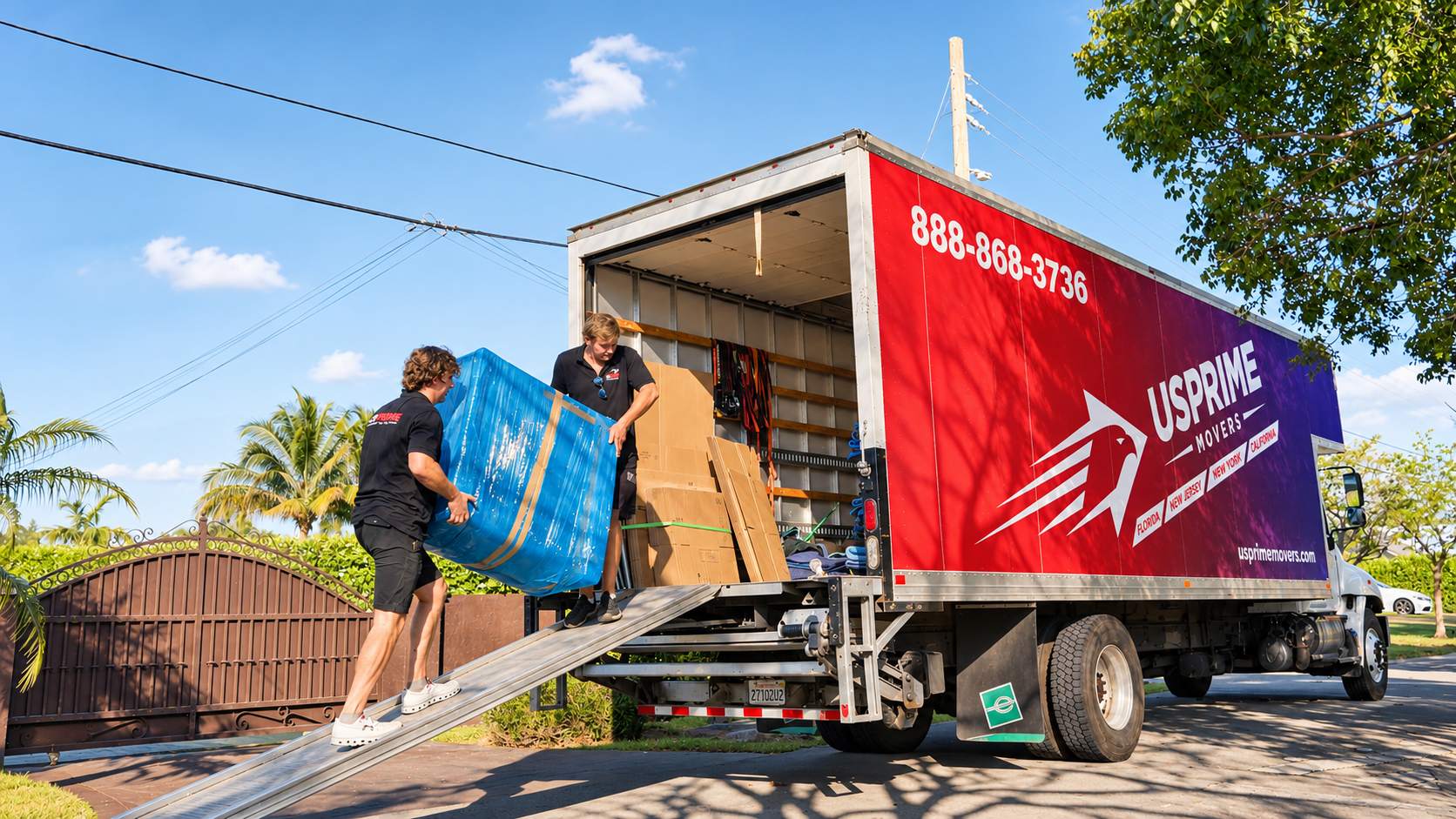
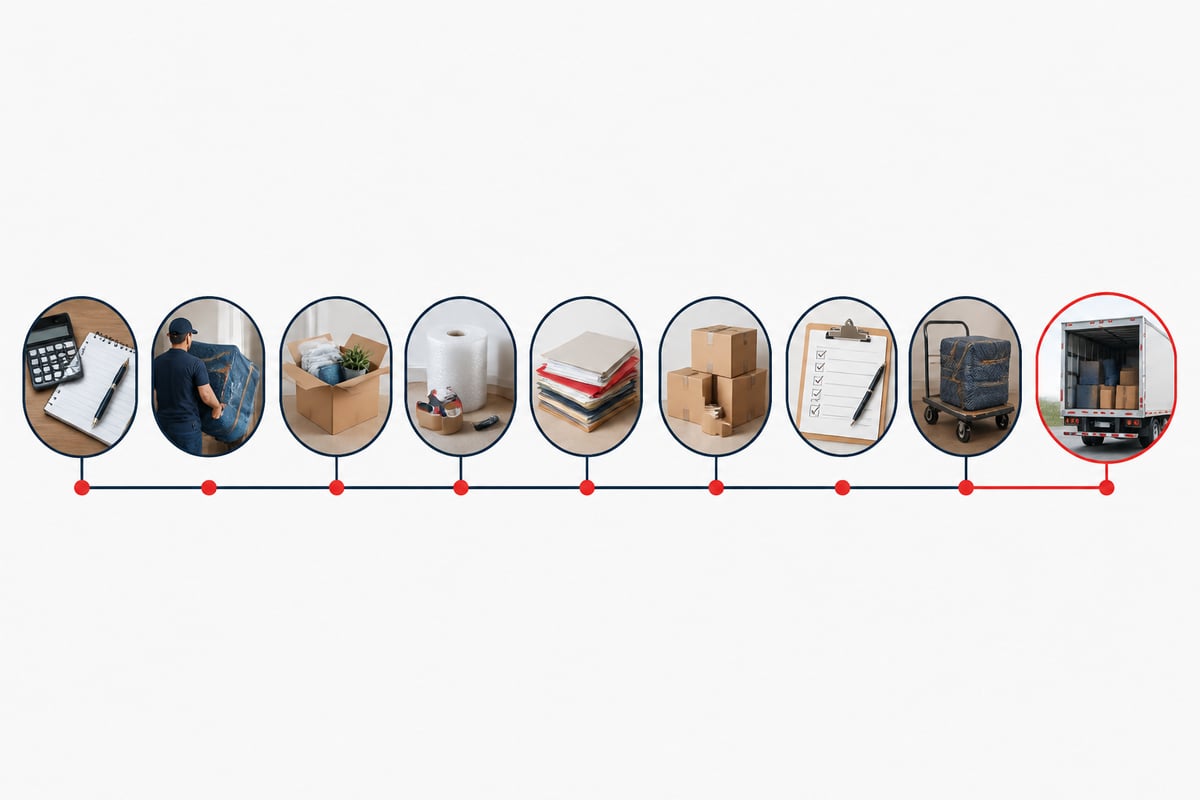
An out-of-state moving checklist works best when you start 8 weeks out. In week 8, set a budget, get written estimates and check each mover's federal registration. The weeks after that cover decluttering, packing, address changes and confirmations, so moving day is a routine event, not a scramble. The timeline below walks through each stage in order.
Long-distance moves have more moving parts than local ones. You may be changing your driver's license, your school district, your doctor and your voter registration. The timeline below keeps those tasks from piling up in the last week.
What should I do first when moving out of state?
The first thing to do is set a budget and a rough move date, then request written estimates from licensed interstate movers. Those two steps shape every other choice you make.
Peak season runs May through September, when moves typically cost more. Mid-week and mid-month dates usually cost less. The earlier you book, the better the price.
Out-of-state moving checklist: 8 weeks to moving day
Here is the full timeline at a glance. Details for each stage follow in the sections below.
| Weeks before move | Main goal | Key tasks |
|---|---|---|
| 8 | Plan and budget | Set date, budget, inventory; check mover registration |
| 7 | Book movers | Compare written estimates, sign the agreement |
| 6 | Declutter | Sort room by room, sell or donate extras |
| 5 | Supplies | Order boxes, plan specialty items, decide on packing help |
| 4 | Records and addresses | Update address, transfer records, notify employer |
| 3 | Pack in earnest | Pack non-daily rooms, label, handle valuables |
| 2 | Confirm | Reconfirm mover, utilities, car and travel plans |
| 1 | Final prep | Pack essentials, defrost, clean, collect keys |
| Moving day | Load and go | Walk through, inspect inventory, sign paperwork |
What goes in weeks 8 and 7: budget, inventory and booking?
In weeks 8 and 7, you build an inventory, set a budget and sign with a licensed carrier. These two weeks decide most of what you'll pay.
Start with a room-by-room inventory. List furniture, boxes you expect to pack and anything unusual, such as a piano, antiques or a safe. Movers price long-distance moves by volume, so a clear list gives you a clear price. A 1-bedroom is typically about 300 to 700 cubic feet, a 2-bedroom 500 to 1,000, and a 3-bedroom 1,000 to 2,000.
Then check the mover. Interstate household-goods movers must be registered with the federal government. FMCSA advises checking a mover's registration, insurance information and complaint records before you hire. US Prime Movers is a licensed interstate carrier (USDOT 3848322, MC 1401881).
How should I read an estimate?
Get the estimate in writing. According to FMCSA's FAQ, a rate quote is not an estimate, and a real estimate should be based on an in-person or virtual inspection. Ask whether it is binding or nonbinding. With a nonbinding estimate, the mover generally cannot require more than 110% of the estimate at delivery, though added items or services can change the amount due.
A binding, not-to-exceed price removes that guesswork. US Prime Movers quotes this way from your inventory, by video call, phone or a list sent by email or text. The price stays fixed while the inventory stays the same. Stairs, an extra stop or extra items can raise it.
Typical long-distance prices by home size and distance, as estimates only (the binding price depends on your inventory):
| Home size | About 400 miles | About 1,000 miles | About 2,500 miles |
|---|---|---|---|
| Studio | $1,050 | $1,450 | $1,750 |
| 1 bedroom | $1,750 | $2,300 | $2,750 |
| 2 bedrooms | $2,400 | $3,150 | $3,750 |
| 3 bedrooms | $3,950 | $5,200 | $6,100 |
| 4 bedrooms | $5,200 | $6,700 | $7,850 |
For a deeper look at what drives the total, see how much it costs to move out of state.
When should you book a full-service interstate carrier?
A full-service carrier handles the heaviest items on your checklist: loading, driving and delivery. Hiring one by week 7 is the single biggest task off your plate.
US Prime Movers' Interstate Moving covers state-to-state residential moves across all 50 states, using its own trucks and background-checked crews. The crew that loads your truck is the crew that delivers it. The price includes wrapping, disassembly and reassembly, room-by-room setup, fuel, tolls and taxes, and basic liability coverage. Long-distance moves also get 30 days of free storage.
- Typical price: see the table above (estimates only).
- Best for: moves where you want one fixed price and a single crew from start to finish.
- Standard delivery windows: up to 500 miles takes 3 to 6 business days; 500 to 1,000 miles, 5 to 10; 1,000 to 2,000 miles, 10 to 21; 2,000 to 3,000 miles, 15 to 21.
What should I do in weeks 6 and 5: declutter and gather supplies?
In weeks 6 and 5, you cut what you own and order what you need to pack. Every item you sell or donate is one less item to pay to move.
Work room by room. Sort into keep, sell, donate and discard. Start with rooms you use least, such as the attic, garage and guest room. Check weight and volume against your inventory, because a smaller load lowers the quote.
Plan specialty items now:
- Pianos, antiques and art need individual pricing and sometimes crating. See piano moving and antique moving for how that works.
- Vehicles can ship through a partner company that prices and ships the car.
- Plants, pets and open food need their own plan. For animals, read moving long distance with pets.
Decide now whether you'll pack yourself. Packing yourself avoids a packing charge. If you'd rather not, US Prime Movers lists full packing at $1.25 per cubic foot, partial packing at $0.75 and unpacking at $0.75.
When should you book packing services?
Packing services make sense when your time is the limiting factor. Booking them by week 5 keeps the pack date from colliding with your work or family schedule.
US Prime Movers' Packing Services include the materials and pack your whole home for long-distance transport. You can choose full or partial packing, plus unpacking at the other end.
- Typical price: full packing $1.25 per cubic foot, partial $0.75, unpacking $0.75.
- Best for: a 3-bedroom or larger home, a tight timeline, or a move where kitchens and fragile rooms need professional wrapping.
What should I handle in week 4: records, addresses and work?
In week 4, you update your address, transfer records and tell the people who need to know. These tasks have lead times that you can't shorten later.
- Submit a USPS change of address.
- Notify your employer, bank, insurers and subscription services.
- Request medical, dental, vet and school records.
- Look up the new state's rules for driver's licenses, vehicle registration and voter registration. Most states set deadlines after you arrive.
- Schedule utility shutoff at the old home and start at the new one, with the start date a day or two early.
- Notify your landlord or arrange your home sale closing timeline.
If you're moving for a job, job relocation moving guide covers what employers often reimburse. Tax rules matter too. According to the IRS, moving-expense deductions are generally limited to active-duty Armed Forces members moving under military orders for a permanent change of station. If you're in that group, keep receipts. US Prime Movers handles PCS and PPM moves and provides certified weight tickets and reimbursement paperwork.
If your move is for a lower cost of living or to be near family, budget for a second set of deposits and fees at the new address. The first month often costs more than expected.

How do I pack in weeks 3 and 2?
Pack the rooms you rarely use first, then work toward the kitchen and bedrooms. Leave daily items for the final week.
- Pack off-season clothes, books, decor and linens first.
- Label every box with the room and a short contents note.
- Number the boxes and keep a simple list so you can spot a missing one at delivery.
- Put valuables, documents and medications in a bag you carry yourself.
- Photograph electronics' cable setups before unplugging.
- Drain fuel from lawn equipment and prepare appliances according to their manuals.
For businesses relocating an office, the same logic applies. Pack archives and spare supplies first, keep active files and IT equipment for last, and assign a point person per department.
For seniors downsizing to another state, pack by decision, not by room. Choose what fits the new home's floor plan first, so no one packs a dining set that won't fit. Moving out of state covers more on pacing a big move.
What should I confirm two weeks out?
Two weeks out, reconfirm everything in writing:
- Confirm the pickup date, arrival window and crew with your mover.
- Confirm the delivery address and who can accept the truck.
- Check stairs, elevators and parking at both homes. If a large truck can't reach the door, a shuttle truck may be needed. US Prime Movers charges $1 per cubic foot for a shuttle (free with expedited delivery), and stairs after the first flight run $75 per flight. Telling the mover now keeps the binding price accurate.
- Review the payment schedule. A common structure is a deposit of 10% to 30% to hold the date, 50% at pickup after loading, and the balance at delivery. Confirm your own contract's terms.
- Confirm your travel plans, including hotel nights and car or flight bookings.
Read the federal Your Rights and Responsibilities When You Move booklet before moving day. It explains required paperwork, estimates and your protections.

What should I include on my moving day checklist?
Your moving day checklist should cover an essentials bag, a walk-through, an inventory check and the signed paperwork. Keep it short so you can follow it while busy.
The week before:
- Pack a bag for each person with clothes, toiletries, chargers and medications.
- Keep a box of first-night items: sheets, towels, paper goods, basic tools.
- Defrost the freezer and empty the fridge.
- Clean as you clear rooms.
On the day:
- Be present for the whole load, or assign a trusted adult.
- Do a walk-through of every room, closet and the garage before the truck leaves.
- Review the inventory list before you sign. Note any existing damage.
- Keep your bill of lading and all contact numbers in your bag.
- Take final meter readings and photos of the empty home.
- Hand over keys as agreed and lock up.
What should I do after I arrive?
After you arrive, check delivery against the inventory, then handle local registrations in order. Do the safety and legal items first, decor later.
- Inspect boxes and furniture as they come off the truck. Note damage on the paperwork before the crew leaves.
- Confirm utilities, locks and smoke detectors work.
- Update your driver's license, vehicle registration and voter registration inside your new state's deadlines.
- Find a doctor, pharmacy and, if needed, schools.
- Unpack kitchens and bedrooms first.
If you're moving with kids, moving long distance with kids and family has pacing ideas for the first weeks.
Can I get a printable checklist for moving out of state?
You can make one from this article in a few minutes. Copy the table above into a document, then add each bullet list under its week and print it.
Add three columns of your own: due date, who is responsible and done. A one-page version helps when more than one adult is sharing the work. Keep the printed copy with your bag of documents on moving day.
FAQ
What should I include on my checklist for relocating to another state?
Include a budget, written estimates, mover registration checks, an inventory, decluttering, supplies, address changes, record transfers, utility dates, a moving-day bag and a post-arrival registration list. The timeline above places each task by week.
How early should I book an out-of-state mover?
Book 6 to 8 weeks ahead, longer in May through September. US Prime Movers says early booking lowers the price and that peak-season moves cost about 40% more.
Does US Prime Movers offer a price match?
Yes. US Prime Movers matches and beats written estimates from reputable moving carriers when you show the written estimate.
What happens if my delivery is late?
US Prime Movers has an On-Time Guarantee: if it delivers late, it reimburses you for each late day. The amounts are set in each customer's agreement.
Can I store my things for a while after the move?
Every long-distance US Prime Movers move includes 30 days of free storage. After that, storage is $0.50 per cubic foot per month, in climate-controlled space. If you need longer, ask.
Today, write down your target move date and make a room-by-room inventory so you can request accurate written estimates. When you're ready to compare, Interstate Moving from US Prime Movers, a family-owned licensed interstate carrier (USDOT 3848322, MC 1401881), gives you a binding, not-to-exceed price based on that inventory. Call (888) 868-3736, 7 days a week, 9 AM to 8 PM, or Get a Free Quote online and lock in your date.