
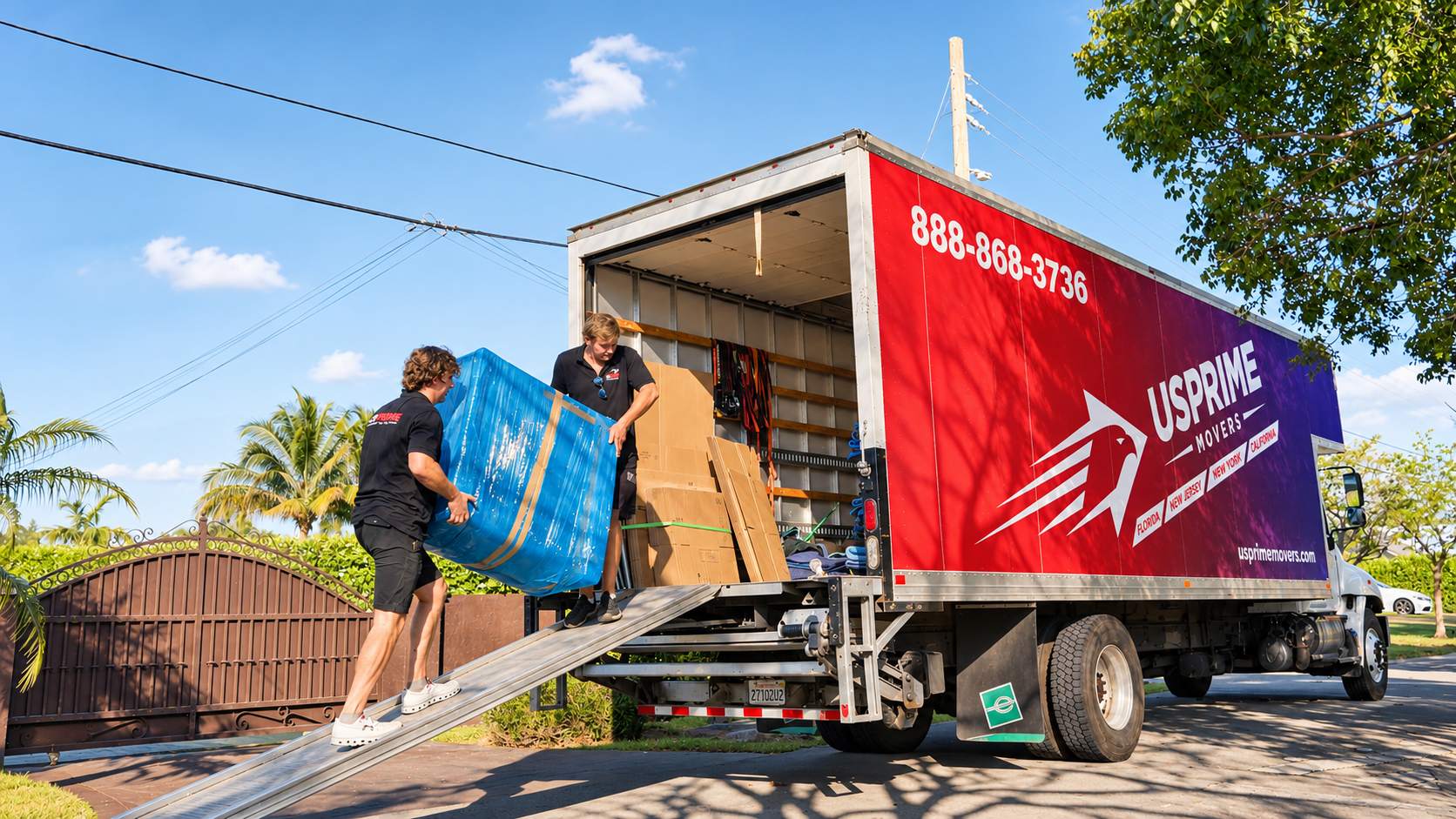
The most useful questions to ask a long-distance mover before you book cover five things: whether it holds federal interstate authority, what kind of written estimate you will get, what the deposit and payment schedule look like, how long delivery will take, and what happens if something breaks or arrives late. Get those five answers in writing and you can compare movers fairly. The same questions also help you spot a quote that looks cheap now and costs more at delivery.
This list is written for families and individuals moving to another state for a job, family or a lower cost of living. Below you will find the questions first, then four well-known movers that show how different companies answer them.
1. Is the mover licensed to move households across state lines?
A mover that crosses state lines needs federal authority from the Federal Motor Carrier Safety Administration (FMCSA), shown as a USDOT number and an MC number. Ask for both numbers before you ask for a price.
Then check them yourself on the FMCSA website. The number should match the company name on your estimate. If the mover can't give you the numbers, or gives you a number that belongs to another business, stop there.
Federal authority is the license that matters for interstate household goods moves. You don't need to chase separate state licenses for each state on your route.
- What to ask: "What are your USDOT and MC numbers, and does the name on them match the name on my estimate?"
- Good sign: Numbers given right away, with a company name that matches.
- Warning sign: A generic business name on the quote and no numbers.
2. Is your estimate binding, non-binding or just a rate quote?
Ask which type of written estimate you are getting, because it decides how much you can owe at delivery. According to the Federal Motor Carrier Safety Administration, a binding estimate limits the amount due at delivery to the estimate, unless the shipment or services change or unforeseen circumstances require a new estimate.
A non-binding estimate works differently. The same FMCSA page says the mover cannot require payment at delivery above 110% of the estimate, and final charges depend on factors like shipment weight and services provided. FMCSA also says a rate quote is not an estimate. For interstate moves, the mover must give you a written estimate covering transportation, accessorial and advance charges.
Questions to put to every mover:
- Is this estimate binding, non-binding or a binding not-to-exceed price?
- What would change the price after I sign? (Stairs, an extra stop, extra items.)
- Is the price based on a video survey, a phone call or an inventory list?
- Is everything in writing?
3. How do you build my price: by weight, by cubic feet or by hourly rate?
Ask what unit the price is built on and who counted it. Long-distance prices are usually based on weight or on volume in cubic feet, and the method changes how you check a quote.
At US Prime Movers, the price is set by cubic feet from your inventory, which you can give by video call, phone, or a list sent by email or text. The price is binding and not-to-exceed while the inventory stays the same. As rough guides, a 1-bedroom home is about 300 to 700 cubic feet, a 2-bedroom 500 to 1,000, and a 3-bedroom 1,000 to 2,000.
Whatever method a mover uses, ask for the inventory in writing. If you later add a dining set that was not on the list, you should expect the price to change. If nothing changed, the price should not.
4. What does the price include, and what costs extra?
Ask for a line-by-line list of what is included, then ask what could be added. Many surprise charges come from items that were never on the original quote.
Ask about each of these:
- Furniture wrapping and padding
- Disassembly and reassembly of beds and tables
- Fuel, tolls and taxes
- Basic liability coverage
- Stairs, long carries and elevators
- Extra stops
- Shuttle service when a large truck can't reach your door
- Storage if your new home isn't ready
For reference, US Prime Movers includes wrapping, disassembly and reassembly, room-by-room setup, fuel, tolls, taxes and basic liability coverage in every long-distance price. Stairs are free for the first flight and $75 per flight after that. An extra stop is $150, and a shuttle truck is $1 per cubic foot. Those are one company's rules, so ask every mover for theirs.
5. How much is the deposit, and when do I pay the rest?
Ask for the full payment schedule before you sign. Deposits and payment timing vary a lot between movers, and a large upfront payment is a risk if the company isn't solid.
A common pattern is a deposit to hold your date, a payment at pickup, and a balance at delivery. At US Prime Movers, a deposit of 10 to 30% secures the date and truck, 50% is paid at pickup after loading, and the balance is paid on delivery.
The U.S. Department of Transportation Office of Inspector General lists low-ball estimates followed by demands for much more money, and withholding goods until payment, as moving-fraud indicators. Two questions protect you here: "Is the price I'm paying today the price I'll pay at delivery?" and "Will you ever hold my belongings for extra payment?"
6. How do you protect my belongings, and how do claims work?
Ask what coverage is included, what it pays, and how a claim is filed. Basic liability coverage is the starting level, and it often doesn't match the value of what you own.
Questions to ask:
- What is included at no extra cost?
- Can I buy more coverage, and who handles the claim if I do?
- Does my homeowner's or renter's policy cover goods in transit?
- How long do I have to report damage, and in what form?
- Who reviews the claim, the mover or an outside company?
At US Prime Movers, basic liability coverage is included free. Extra coverage can be bought through its insurance partner Baker International, and the insurer handles claims on that coverage. You can also use your own homeowner's insurance. Extra coverage prices are set by the insurer.
7. Will the same crew load and deliver, and are they employees?
Ask who will actually touch your belongings, and whether the crew that loads is the crew that delivers. Some movers sell the job and then hand it off to another company.
Ask directly: "Are the crews your own employees, or subcontracted?" and "Are background checks done?" Also ask whether your items will ride on a truck with other households, which is common on long-distance moves, and how items are kept separate.
US Prime Movers uses its own trucks and its own background-checked crews, and the crew that loads your truck is the crew that delivers it.
8. How long will delivery take, and what happens if it's late?
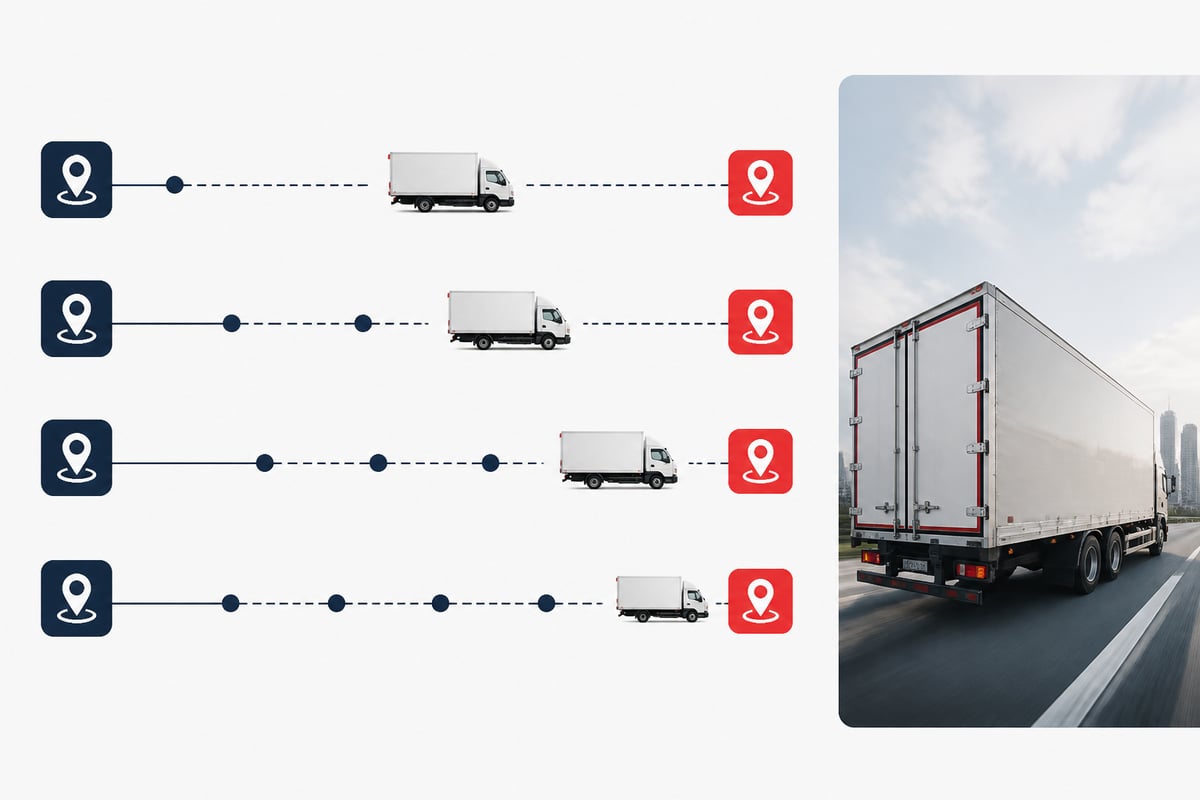
Ask for a delivery window in writing, not a promise by phone. Long-distance delivery times depend on mileage and on how the truck is routed.
US Prime Movers' standard windows run from 3 to 6 business days for up to 500 miles, 5 to 10 days for 500 to 1,000 miles, 10 to 21 days for 1,000 to 2,000 miles, and 15 to 21 days for 2,000 to 3,000 miles. Expedited delivery is a dedicated straight run, where the truck leaves the day after loading. Its price is set per move.
Then ask about lateness. At US Prime Movers, an On-Time Guarantee means the company reimburses you for each late day, with amounts set in your agreement. Any mover should be able to tell you what, if anything, it owes you if the window is missed.
9. Where will my things stay if my new home isn't ready?
Ask whether storage is included and how much it costs after that. A closing delayed by a week can turn into a storage bill you never planned for.
Ask about the length of any free storage, the monthly rate after it, whether the space is climate-controlled, and whether your items stay on the truck or go into a warehouse. At US Prime Movers, every long-distance move includes 30 days of free storage, and storage after that is $0.50 per cubic foot per month in climate-controlled space. If you need longer, you can ask.
10. What will you refuse to move, and what packing do you offer?
Ask for the list of items the mover won't carry, and what it charges for packing. Movers commonly won't transport things like flammables, so you'll need a plan for them well before moving day. The what items movers cannot transport guide covers the usual list.
Also ask about special items. Pianos, antiques and art are usually priced individually, because crating or special handling may be needed. For a piano, the piano moving service page explains what to expect.
On packing, US Prime Movers charges $1.25 per cubic foot for full packing, $0.75 for partial packing, and $0.75 for unpacking. Packing yourself avoids the packing charge.
11. How four well-known movers compare
These four are well-known names that show how answers differ on price, deposit and estimate type. Figures come from the research listed below and are approximate. Your binding price depends on your inventory and route, so treat these as starting points only.
International Van Lines
International Van Lines is a nationwide mover available in 50 states and Washington, D.C. Research lists an estimate of about $4,252 for a 500-mile move and a 4.5 rating from ConsumerAffairs. It offers both binding and nonbinding estimates, and deposits vary, with 25% being common.
Suits: a full-service move where wide nationwide coverage matters. Verdict: a broad option, with the highest estimate of the four.
Allied Van Lines
Allied Van Lines has an average price of about $3,520 and a 4.9 out of 5 rating from This Old House. No deposit is listed, and it works as a carrier and broker, so ask who will actually do your move.
Suits: a move where no listed deposit matters to you. Verdict: highly rated, but confirm who handles the job.
JK Moving Services
JK Moving Services has an average price of about $2,273 and a 4.6 out of 5 rating from This Old House. The deposit is $250, and it operates as a carrier.
Suits: a move where a lower average price and a small flat deposit matter. Verdict: a lower quoted price, so check what's included.
PODS
PODS is a container-based option with an estimate of about $2,694 for a 500-mile move and a 4.5 rating from ConsumerAffairs. The estimate is nonbinding, it is available in 44 states and Washington, D.C., and deposits vary.
Suits: a move where you are willing to load and unload the container yourself to save money. Verdict: affordable, but it is not a full-service crew move.
US Prime Movers
US Prime Movers is a family-owned, licensed interstate mover (USDOT 3848322, MC 1401881) that moves between all 50 states with its own trucks and crews. Two services fit this list:
- State-to-State Moving: residential moves between any of the 50 states.
- Long Distance Moving: full-service long-distance moves, including loading, transport and unloading.
Typical long-distance estimates run from $1,750 for a studio or 1-bedroom under 500 miles to $4,950 for four or more bedrooms over 1,500 miles. The binding price depends on your inventory. For route examples, a 2-bedroom from New Jersey to Florida is about $2,500.
Suits: a full-service family move with one binding price. Verdict: a fit when you want your own crew and a not-to-exceed price.
Quick comparison
| Option | Approx. price | Estimate type | Deposit | Coverage area |
|---|---|---|---|---|
| International Van Lines | About $4,252 (500 miles) | Binding or nonbinding | Varies; 25% common | 50 states and D.C. |
| Allied Van Lines | About $3,520 average | Not listed | None listed | Not listed |
| JK Moving Services | About $2,273 average | Not listed | $250 | Not listed |
| PODS | About $2,694 (500 miles) | Nonbinding | Varies | 44 states and D.C. |
| US Prime Movers | From $1,750 (studio, under 500 miles) | Binding, not-to-exceed | 10-30% | 50 states |

12. How should I time the move to get a lower price?
Book early and avoid peak months if you can. The earlier you book, the better the price, and peak season from May through September costs about 40% more. Mid-week and mid-month moves tend to cost about 15 to 30% less.
If your date is fixed by a job start, you can still ask for a few alternate pickup days and compare. Our best time of year to move long distance page goes further on seasonal choices. To trim cost before the truck arrives, downsizing before a long-distance move lowers the volume, which lowers a cubic-foot price.
13. How do I plan a long-distance move step by step?
Start about two months out and work in this order:
- Take inventory of every room, including the garage and storage areas.
- Request written estimates from at least three licensed movers.
- Check each mover's USDOT and MC numbers on the FMCSA site.
- Compare estimate type, inclusions, deposit and delivery window.
- Book, and get the final inventory and payment schedule in writing.
- Sort, donate and pack what you will move yourself.
- Confirm pickup details, access and parking a few days before.
- Check items at delivery and note any damage before the crew leaves.
If you plan to compare pricing, the moving company quote page explains what a quote should contain. For a sense of totals, how much it costs to move out of state lists typical ranges.
14. Should I tip, and what is a fair amount?
Tipping is optional, and it is a thank-you for good work rather than a bill. Many people give each crew member a flat amount at the end of the day, though the right figure depends on the size and difficulty of the move. Cold drinks and a clear path through the house are also appreciated.
FAQ
What questions do you ask movers?
Ask about federal licensing (USDOT and MC numbers), estimate type, what the price includes, the deposit and payment schedule, delivery window, coverage and claims, and who will do the work. The sections above give the wording.
What items will movers not pack?
Movers commonly won't transport flammables, corrosives, perishable food and similar hazardous items. Cash, jewelry and important papers are usually best carried yourself. Ask each mover for its own list in writing.
Is a binding estimate better than a non-binding one?
A binding estimate caps what you owe at delivery as long as your shipment and services stay the same. A non-binding estimate can rise, though FMCSA says the mover can't demand more than 110% of it at delivery.
How far ahead should I book a long-distance mover?
Book as early as you can. Earlier booking tends to give a better price, and summer dates fill up fast.
Can I get a price without a home visit?
Often yes. US Prime Movers, for example, builds a binding price from an inventory you give by video call, phone, or a list sent by email or text.
Your next step is to write down your inventory and ask three licensed movers the questions above, with every answer in writing. If you're moving to another state and want one binding price from our own crew, US Prime Movers can price your inventory right after a quick call, so you can get a free quote at usprimemovers.com/get-your-quote or call (888) 868-3736, 7 days a week, 9 AM to 8 PM.