
Planning a long-distance move means making dozens of decisions, and one of the most important involves how you'll handle the logistics and timing of your relocation. Storage pods have become an increasingly popular option for homeowners and renters who need flexible moving and storage solutions, but understanding the full financial picture requires looking beyond the advertised base rates. The true storage pods cost includes multiple components that can significantly impact your budget, from container delivery and pickup fees to insurance, mileage charges, and monthly rental extensions. This comprehensive guide breaks down exactly what you'll pay in 2026, helping you evaluate whether portable storage containers make sense for your specific situation or if alternative solutions might better serve your needs and budget.
Understanding Base Storage Pods Cost Structure
The foundation of storage pods cost begins with the container rental itself, but this represents just one piece of the total expense. Most portable storage companies charge separately for the container rental period, delivery and pickup, and the actual transportation if you're moving long distances.
Container rental feestypically operate on a monthly basis, with costs varying significantly based on three primary factors:
- Container size: Smaller units (7-8 feet) cost less than larger containers (12-16 feet)
- Rental duration: Monthly rates often decrease with longer commitments
- Geographic location: Urban areas and high-demand markets command premium pricing
According tocurrent market data, monthly rental fees for portable storage containers range from $149 to $349 depending on size and location. The smallest containers suitable for a studio apartment or dorm room start around $149 monthly, while the largest 16-foot containers capable of holding a three-bedroom home's contents can exceed $289 per month.
Delivery and Pickup Charges
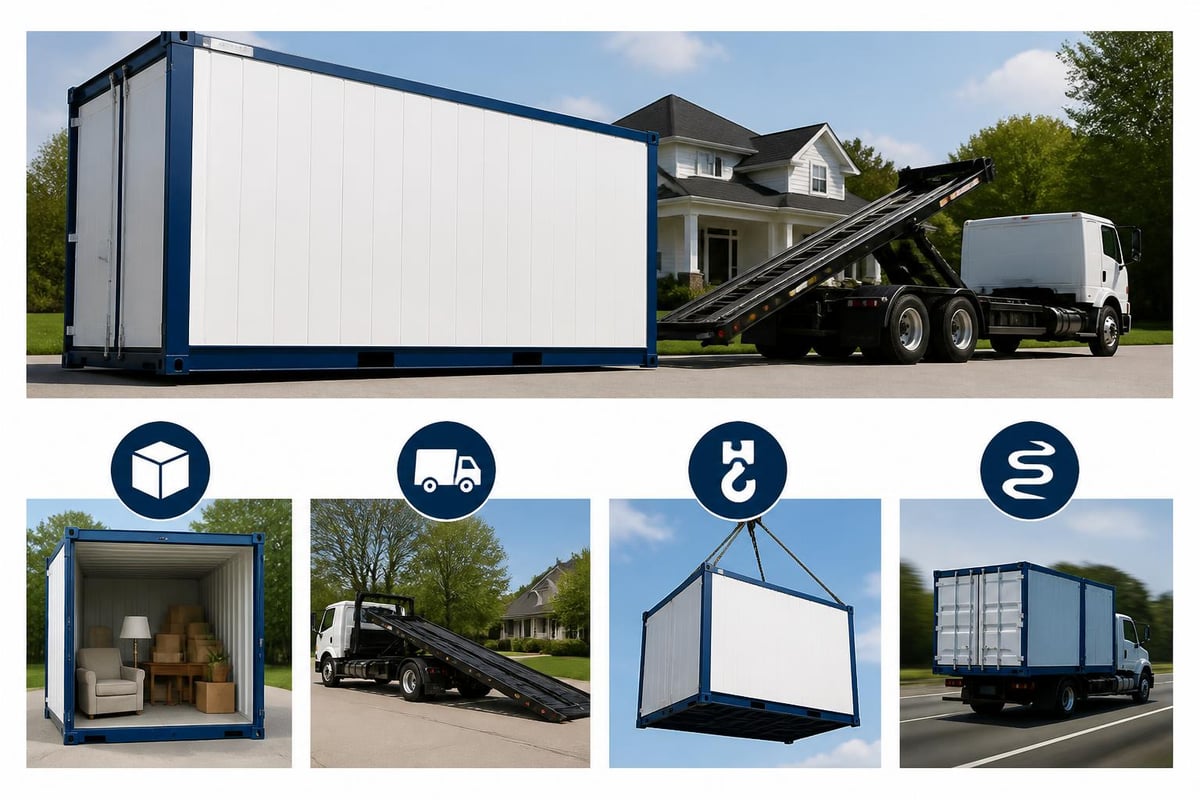
Beyond the monthly rental, delivery and pickup fees represent substantial upfront costs that catch many customers off guard. These one-time charges cover the specialized equipment and labor required to transport the empty container to your location and retrieve it later.
Standard delivery and pickup fees typically include:
- Transportation of the empty container to your address
- Precise placement using hydraulic lift systems
- Final pickup and removal when you're finished
- Basic positioning adjustments during delivery
Industry pricing analysisshows delivery fees ranging from $74 to $229 per trip, with pickup charges following similar pricing structures. Combined, you're looking at $150 to $450 in delivery and pickup costs alone before factoring in the actual storage or transportation of your belongings.
Geographic factors heavily influence these fees. Delivery to rural areas or locations requiring specialized access routes incurs premium charges, while delivery within major metropolitan service areas tends toward the lower end of the pricing spectrum.
Storage Pods Cost by Container Size
Container size directly impacts both your monthly rental rate and overall project costs. Choosing the right size prevents paying for unused space while ensuring adequate capacity for your belongings.
| Container Size | Typical Capacity | Monthly Rental Range | Best For |
|---|---|---|---|
| 7-8 feet | 1-2 rooms | $149-$199 | Studio apartments, dorm rooms, small offices |
| 12 feet | 2-3 rooms | $189-$249 | 1-2 bedroom apartments, partial homes |
| 16 feet | 3-4 rooms | $239-$349 | 2-3 bedroom homes, full households |
The 16-foot container represents the most common choice for families relocating from standard single-family homes. With approximately 830 cubic feet of storage capacity, this size accommodates most three-bedroom households when properly packed and organized.
Calculating Your Size Requirements
Accurately estimating your container needs prevents costly sizing mistakes. Consider these practical guidelines:
For a one-bedroom apartment: A 12-foot container typically provides sufficient space for furniture, boxes, and personal items. Budget for storage pods cost between $400-$600 for a one-month rental including delivery and pickup.
For a three-bedroom home: Most families require either one 16-foot container or two 12-foot containers. The single larger unit usually costs less than multiple smaller containers when you factor in separate delivery fees for each unit.
Professional packing services can reduce the container size you need by maximizing space efficiency. Considerprofessional packing and unpacking servicesif you're concerned about fitting everything into your chosen container size.
Long-Distance Transportation Costs
When your storage pod needs to travel across state lines, transportation charges add substantially to your total expenses. Unlike local storage scenarios where the container sits at a facility near your home, long-distance moves involve physically transporting the loaded container to your destination.
Long-distance storage pods cost calculations include:
- Base transportation fee covering fuel and driver labor
- Per-mile charges beyond included distance thresholds
- Cross-country premium rates for routes exceeding 1,000 miles
- Seasonal adjustments during peak moving months (May-September)
According tocomprehensive pricing data, coast-to-coast moves using portable storage containers typically range from $3,000 to $7,500 depending on container size and specific route. A move from New York to California with a 16-foot container generally costs between $4,500 and $6,000, while shorter regional moves like Texas to Florida might run $2,500 to $4,000.
These figures assume standard door-to-door service with one delivery and one pickup. Additional stops, extended storage periods at either location, or specialized handling requirements increase costs proportionally.

Comparing Storage Pods to Traditional Moving Services
The storage pods cost structure differs fundamentally from traditionallong-distance moving servicesoffered by full-service moving companies. Understanding these differences helps you make informed financial decisions.
Storage pods advantages:
- Flexible loading and unloading timelines
- No rush to complete packing in a single day
- Container stays accessible at your location
- Pay only for the container size you need
Traditional moving services advantages:
- Professional loading reduces damage risk
- Faster total transit time door-to-door
- No concerns about proper weight distribution
- Comprehensive insurance coverage included
For long-distance relocations requiring temporary storage, combinedmoving and storage solutionsfrom full-service companies often provide better value than extended portable container rentals.
Hidden Fees and Additional Charges
The advertised storage pods cost rarely reflects your final bill. Several additional fees and surcharges apply to most container rentals, and understanding these charges prevents budget surprises.
Insurance and Protection Plans
Portable storage companies offer various insurance tiers, but your homeowners or renters insurance may already cover belongings in temporary storage. Review your existing coverage before purchasing duplicate protection.
Typical insurance options include:
- Basic coverage: Usually included, covers minimal liability ($5,000-$10,000)
- Enhanced protection: $10-$40 monthly, extends coverage to $20,000-$50,000
- Full replacement value: $30-$100 monthly, covers complete replacement costs
Most companies require you to explicitly decline additional insurance in writing, as the included basic coverage proves insufficient for most households' belongings.
Access Fees and Storage Facility Charges
If your container sits at a company storage facility rather than your property, access fees apply when you want to retrieve items. Some companies charge $25-$75 per facility visit, while others include limited monthly visits in the base rental rate.
Monthly cost breakdownsreveal that storage facility charges add $50-$150 monthly compared to keeping the container at your residence. However, facility storage makes sense when you lack suitable space for the container or need climate-controlled storage for sensitive items.
Seasonal Price Variations and Timing Strategies
Storage pods cost fluctuates significantly based on seasonal demand patterns. Understanding these cycles enables strategic timing that can save hundreds or even thousands of dollars on your move.
Peak season pricing (May-September):
- Container availability becomes limited
- Delivery and pickup fees increase 15-30%
- Monthly rental rates rise $30-$80 per container
- Long-distance transportation premiums add $500-$1,200
Off-season advantages (October-April):
- Better container availability and scheduling flexibility
- Promotional discounts reduce base costs 10-25%
- Waived or reduced delivery fees
- Negotiating leverage for multi-month rentals
Planning your move during the off-season requires flexibility with your timeline, but the savings justify the adjustment for many families. A cross-country move in November might cost $3,800 compared to $5,200 for the identical move in July.
Multi-Month Rental Discounts
Extended rental periods beyond three months often qualify for volume discounts. Monthly rates decrease progressively as your rental duration increases, making long-term storage more economical than sequential monthly rentals.
| Rental Duration | Discount Range | Effective Monthly Cost |
|---|---|---|
| 1 month | Standard rate | $289 (16-ft container) |
| 3 months | 5-10% discount | $260-$275 per month |
| 6 months | 15-20% discount | $231-$246 per month |
| 12 months | 25-30% discount | $202-$217 per month |
Request a detailed quote covering your full anticipated rental period rather than assuming month-to-month extensions. Companies often provide substantial discounts for upfront commitments that aren't advertised in standard pricing.

Cost-Effective Alternatives to Storage Pods
While portable storage containers offer unique advantages, several alternatives merit consideration depending on your specific moving scenario and budget constraints. Each option presents distinct cost structures and tradeoffs worth evaluating.
Traditional Storage Facilities
Self-storage units at conventional facilities represent the most common alternative, with pricing structures fundamentally different from portable containers.Comparative analysisreveals important distinctions between these approaches.
Traditional storage unit advantages include:
- Lower monthly rental rates ($50-$200 for comparable sizes)
- No delivery or pickup fees
- Month-to-month flexibility without minimum commitments
- Immediate access during facility hours
Disadvantages to consider:
- You handle all loading, transportation, and unloading
- Requires renting a moving truck separately
- Multiple trips needed to fully load/unload the unit
- Additional labor costs if hiring help
Total costs for traditional storage depend heavily on whether you already own or have access to a suitable moving vehicle. Renting a moving truck for multiple days to load a storage unit can quickly eliminate the monthly rental savings compared to storage pods cost.
Full-Service Moving Companies
Professional moving companies provide comprehensive solutions that eliminate most logistics headaches, though at premium pricing compared to do-it-yourself container options. The convenience factor and reduced physical labor justify higher costs for many families, particularly those with substantial households or limited time for extended packing and loading periods.
Obtaining detailed quotes from multiple professional movers allows direct comparison with storage pods cost. For straightforward long-distance relocations without complex storage requirements, professional movers often prove more economical once you calculate the total time investment and physical effort required for container-based moves.
Regional Price Variations Across the United States
Geographic location dramatically impacts storage pods cost through several mechanisms including local competition levels, facility density, labor costs, and transportation infrastructure. Understanding regional pricing patterns helps set realistic budget expectations.
High-Cost Markets
West Coast metropolitan areas(San Francisco, Los Angeles, Seattle):
- Monthly container rentals run 20-35% above national averages
- Delivery fees reach $200-$280 per trip
- Limited parking and access constraints add surcharges
- 16-foot container monthly costs: $320-$400
Northeast corridor(New York, Boston, Washington DC):
- Urban density and parking restrictions increase placement costs
- Specialized equipment needs for multi-story buildings
- Monthly premiums of 15-25% over baseline rates
- Tight scheduling windows due to high demand
Budget-Friendly Regions
Midwest and Southeast marketsgenerally offer the most competitive storage pods cost structures:
- Monthly rentals 10-20% below coastal pricing
- More flexible delivery and placement options
- Lower transportation costs for regional moves
- Greater availability during peak seasons
A 16-foot container in Dallas or Atlanta might cost $240 monthly with $150 combined delivery and pickup fees, while the identical container in San Francisco runs $380 monthly with $260 in delivery charges.
Making the Financial Decision
Evaluating whether storage pods represent good value for your specific situation requires comprehensive cost comparison including all expenses over your full project timeline. Many families discover that what seemed like an economical solution becomes expensive once they account for extended rental periods, additional fees, and the substantial physical labor involved in loading and unloading containers themselves.
Total Cost Calculation Example
Scenario: Moving a three-bedroom home from Florida to Texas (1,200 miles) with two weeks of loading time and one week of unloading time.
Storage pod option(16-foot container):
- First month rental: $279
- Delivery fee: $129
- Long-distance transportation: $2,800
- Pickup fee: $129
- Insurance upgrade: $35
Total: $3,372
Professional moving company alternative:
- Full-service packing and loading: Included
- Transportation: $3,200-$3,800
- Unloading at destination: Included
- Basic insurance: Included
Total: $3,200-$3,800
The storage pod appears cheaper initially, but this calculation excludes the substantial physical labor, time investment, and potential need for additional equipment rental to properly load the container. Factor in three days of truck rental to acquire packing materials and transport items to the container, plus potential helper costs, and the numbers shift considerably.
Questions to Guide Your Decision
Before committing to storage pods, honestly assess these critical factors:
Physical capability: Can you safely lift and load furniture and heavy boxes for multiple days?
Time availability: Do you have sufficient schedule flexibility to pack and load over several days or weeks?
Access requirements: Will you need to access stored items during the rental period?
Storage duration: Are you certain about your timeline, or might delays extend your rental unexpectedly?
Budget contingency: Can you absorb potential additional costs for extended rentals or complications?
For families with tight timelines, limited physical capability, or valuable/fragile items requiring professional handling, the premium for full-service professional moving often proves worthwhile despite higher upfront costs. Thecomprehensive servicesprovided by experienced moving companies eliminate many variables and risks associated with self-service container moves.
Strategies to Minimize Storage Pods Cost
If portable storage containers best fit your moving situation, several proven strategies reduce your total expenses without sacrificing service quality or convenience.
Timing and Scheduling Optimization
Book during off-peak months: Scheduling your move between October and April typically saves 15-25% compared to summer peak season. This single decision might reduce a $4,500 move to $3,375, a savings of $1,125.
Minimize rental duration: Every day the container sits at your location accrues charges. Organize packing efficiently to complete loading quickly, then schedule prompt pickup. Even a few days' reduction in rental time saves money on daily storage rates.
Coordinate delivery and pickup precisely: Avoid situations where the container arrives before you're ready to load or sits waiting for pickup after you've finished. Each day of unnecessary rental adds to your storage pods cost.
Size and Capacity Management
Choosing the smallest container that adequately holds your belongings prevents paying for unused space. However, undersizing creates worse problems:
- Forcing items to fit damages furniture and boxes
- Multiple containers cost more than one properly-sized unit
- Poor weight distribution causes transportation issues
- Cramped packing increases damage risk
Request a detailed inventory consultation to accurately assess your container needs. Many companies provide virtual or in-person assessments that examine your belongings and recommend appropriate sizing.
Negotiation and Discount Opportunities
Storage pod companies, like most service providers, maintain flexibility in their pricing structures. Several discount opportunities exist for customers who ask:
- Multi-month discounts: Commit to longer rental periods upfront
- Military discounts: Many companies offer 10-15% discounts for active duty and veterans
- Referral credits: Existing customer referrals often generate mutual discounts
- Competitor matching: Some companies match or beat competing quotes
- Seasonal promotions: Watch for limited-time offers during slow periods
Always request itemized quotes from multiple providers and use competing offers as negotiating leverage. A simple phone call mentioning a competitor's lower pricing frequently results in matched rates or additional concessions.
Understanding the complete financial picture of storage pods cost empowers you to make informed decisions that align with your budget, timeline, and moving requirements. While portable storage containers offer valuable flexibility and convenience for certain situations, they're not automatically the most economical choice for every relocation. When you need expert guidance, comprehensive services, and transparent pricing for your long-distance move,US Prime Moversprovides fully licensed and insured moving solutions nationwide with a focus on reliability and customer care. Request your free quote today to compare options and discover how our family-owned company can simplify your upcoming relocation.