
A binding estimate fixes your price for the items and services listed. A non-binding estimate is only a guess, and the final bill depends on actual weight and services. A not-to-exceed estimate sets a ceiling: you pay the lower of the estimate or the actual cost. Binding vs non-binding vs not-to-exceed moving estimates comes down to one question: who carries the risk if your shipment turns out heavier or lighter than expected?
This guide explains each type in plain words. It covers what federal rules say, what each can cost you, and which one makes sense when you move to another state.
What is a moving estimate, and why does the type matter?
A moving estimate is a written statement of what the mover expects to charge, and its type decides whether that number can change at delivery. Two estimates with the same dollar figure can lead to very different final bills.
Federal rules require a mover to give you a written estimate of total charges and to label it as binding or non-binding before issuing the bill of lading, according to the FMCSA Safety Planner. So if a company only gives you a number over the phone and never says which kind it is, ask. Get the type in writing.
For a move across state lines, the stakes are higher than for a local move. Long-distance pricing is tied to volume or weight and to mileage. A small change in either can move the total by hundreds of dollars.
How do moving companies determine cost?
Movers set cost from the size of your shipment, the distance, and the services you add. Size is measured either by weight on a scale or by cubic feet from your inventory.
Here are the usual inputs:
- Volume or weight. More items mean a bigger truck load and a higher price.
- Distance. Longer routes cost more, and many carriers price in mileage bands.
- Services. Packing, disassembly, storage, and special handling add charges.
- Access. Stairs, long carries, or a street a large truck can't enter can add fees.
- Timing. Peak season, May through September, usually costs more. At US Prime Movers, peak season runs about 40% higher, and mid-week or mid-month moves cost roughly 15% to 30% less.
For context, a 1-bedroom home is typically about 300 to 700 cubic feet, a 2-bedroom about 500 to 1,000, and a 3-bedroom about 1,000 to 2,000. If you want a wider look at how totals build up, the moving company cost guide breaks it down further.
What is a binding estimate?
A binding estimate is a written agreement that guarantees the total cost of your move for the quantities and services listed. Under federal rules, the mover generally cannot require more than that estimate at delivery for the listed work.
The key words are "listed" and "quantities." If you add furniture, ask for packing you didn't list, or the move needs services that were not in the agreement, the price can change. A binding estimate protects you from surprises in the scale weight. It does not protect you from changes you cause.
Where binding works well: moves where your inventory is clear and unlikely to change, such as a family relocating a full household with a firm list of what's coming.
Watch for: a binding price that is simply padded high. Compare it against other written estimates before you sign.
What is a non-binding estimate, and can you give an example?
A non-binding estimate is not a guaranteed final price. Final charges are based on actual shipment weight, the services provided, and the mover's tariff.
Hypothetical example: a non-binding estimate is written on a projected weight. If the shipment is weighed heavier than projected, the final bill rises. If it weighs less, the bill drops. The estimate is only a starting point.
Federal rules limit what you must pay at delivery on a non-binding estimate: the mover cannot require more than 110% of the estimate at that time. Any remaining charges are billed afterward, with payment due within 30 days. If conditions at pickup or delivery require extra services (called impracticable operations), up to 15% of the other charges due at delivery can be added for them. Ask the mover how this applies to your agreement.
Non-binding estimates are not "bad." They can work for small shipments or when weight is truly unknown. But on a cross-country move, the open-ended nature of the bill is the main risk.
What is a binding not-to-exceed estimate?
A binding not-to-exceed estimate sets a maximum price, and your final cost can be lower but never higher for the listed work. It combines a guaranteed ceiling with the chance of paying less if your shipment weighs less than expected.
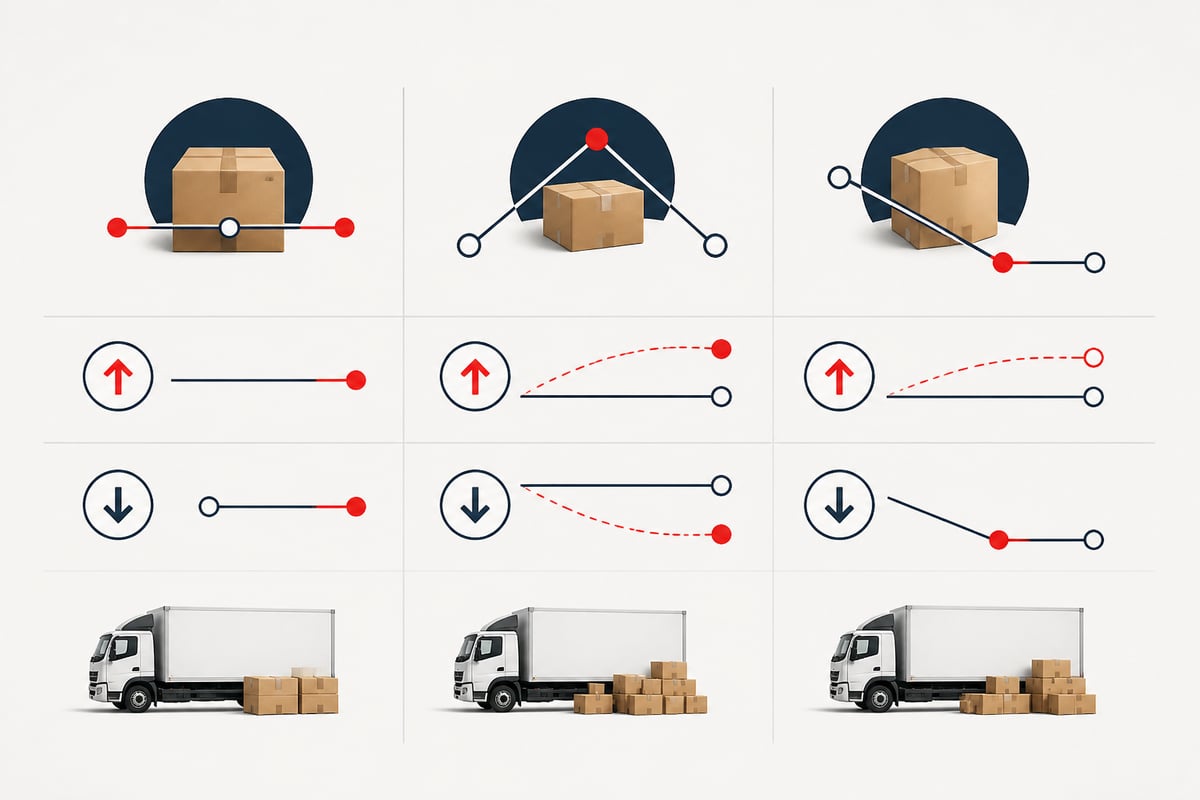
Here is how the three types compare:
| Feature | Binding | Non-binding | Binding not-to-exceed |
|---|---|---|---|
| Price can go up at delivery (same inventory) | No | Yes, based on weight and services | No |
| Price can go down | No | Yes | Yes |
| Basis of final charge | The agreed price | Actual weight and tariff | The lower of actual cost or the estimate |
| Main risk for you | Paying for space or weight you didn't use | An open-ended final bill | Few, if the inventory stays the same |
| Best fit | Clear, fixed inventory | Small or unknown shipments | Most long-distance household moves |
Which estimate is right for a long-distance move?
For most households moving to another state, a binding not-to-exceed price gives the most protection, because it caps your cost while keeping your inventory the only thing that can change it. Which one fits you depends on how sure you are about what's going on the truck.
- Job relocations with a firm start date. You need a number you can budget and, in some cases, submit to an employer. A fixed ceiling helps.
- Lower-cost-of-living moves. The reason for moving is often to save money. An open-ended bill works against that goal.
- Seniors downsizing. Inventory often shrinks as you sort. A not-to-exceed price lets the final cost drop if you take less.
- Adult children moving a parent. A written ceiling gives the family one clear number to plan around.
If you are still deciding what will move and what will be donated, a not-to-exceed structure is more forgiving than a plain binding figure. If your inventory is truly locked, binding and not-to-exceed will look similar.

How does US Prime Movers price long-distance moves?
US Prime Movers gives one binding, not-to-exceed price, based on your inventory, for its State-to-State Moving service. Pricing is by cubic feet, and you can share your inventory by video call, phone, or a list sent by email or text. You get a binding price right after a quick call.
The price holds as long as the inventory stays the same. Three things can raise it: stairs, an extra stop, or extra items. Here is how those are handled:
- Stairs: the first flight is free, then $75 per flight.
- Extra stop: $150 each.
- Shuttle truck, when a large truck can't reach the door: $1 per cubic foot.
Included in the price are furniture wrapping and padding, disassembly and reassembly, room-by-room setup, fuel, tolls, taxes, and basic liability coverage. Long-distance moves also include 30 days of free storage.
Typical long-distance prices are estimates, and your binding price depends on your inventory. A studio or 1-bedroom runs about $1,750 under 500 miles, $1,950 for 500 to 1,500 miles, and $2,350 over 1,500 miles. A 2-bedroom runs about $1,850, $2,750, and $2,950 across those same bands. A 3-bedroom runs about $2,500, $3,200, and $3,950. For a 4-bedroom or larger home, expect about $4,000 for 500 to 1,500 miles and $4,950 over 1,500 miles. For a wider range of figures, see our moving prices guide.
What can still change a binding or not-to-exceed price?
A binding price can still change if the work changes. The estimate covers the items and services written on it, and nothing else.
The common triggers are:
- Added inventory. Boxes or furniture that weren't on your list.
- Extra services. Packing you requested later, or special handling for a piano or antique.
- Access problems. Stairs, long carries, or a street a full-size truck can't enter.
- An added stop. A second pickup or drop-off.
There is also a federal rule for impracticable operations. Charges for services required because of those conditions can be collected at delivery, but they are capped at 15% of the other charges due at delivery. The rest is billed afterward, with payment due within 30 days.
The practical lesson: describe your home honestly. Mention the third-floor walk-up, the shed, and the garage shelves. A price built on an accurate list is the price you pay.

How do you get an accurate estimate?
You get an accurate estimate by giving the mover a complete, honest inventory and getting the result in writing. The estimate is only as good as the list behind it.
Follow these steps:
- Walk every room, plus the garage, attic, basement, and storage unit. Count furniture and note what is large or fragile.
- Decide what you are not taking. Sell, donate, or toss before the estimate, not after.
- Share the inventory with the mover. A video call lets the mover see items directly. A written list by email or text also works.
- Tell them about access. Stairs, elevators, long carries, and tight streets.
- Ask for the estimate type in writing. It should say binding, non-binding, or binding not-to-exceed.
- Confirm what is included. Wrapping, disassembly, fuel, tolls, taxes, and coverage should be spelled out.
- Compare at least two written estimates. US Prime Movers matches and beats written estimates from reputable carriers when you show it the estimate.
If you are moving a very large piece, such as a piano, ask for separate pricing. Special items are priced individually because they can need crating or hoisting. See the notes on piano moving service for what to expect.
What red flags should you watch for in a moving estimate?
The biggest red flag is a price that arrives without anyone asking about your home. A real estimate needs an inventory.
Watch for these:
- No estimate type stated. Federal rules call for the estimate to be labeled as binding or non-binding.
- A phone quote with no inventory review. The number is a guess.
- A price far below the others. It may be built to rise later.
- A large cash demand before loading. A deposit is normal. Pressure for the full balance up front is not.
- No USDOT and MC numbers. Interstate household goods movers need federal FMCSA authority. Check the numbers on the FMCSA site before you pay anything.
- Vague language about "additional charges." Ask which ones and at what rates.
US Prime Movers' payment schedule is simple: a deposit of 10% to 30% secures your date and truck, 50% is paid at pickup after loading, and the balance is paid on delivery. Its USDOT number is 3848322 and its MC number is 1401881.
Frequently asked questions
What does a non-binding estimate mean?
It means the quote is not a guaranteed price. Your final charge is based on the actual weight of your shipment, the services provided, and the mover's tariff, so the bill can end up higher or lower than the estimate.
What is binding vs non-binding?
A binding estimate guarantees the total for the listed items and services. A non-binding estimate only predicts the cost, and the real price is set after the move based on weight and services used.
Can a moving company charge more than a binding estimate?
Only if the work changes. Extra items, added services, stairs, or an extra stop that weren't in the agreement can change the price. For the same listed inventory and services, the mover generally cannot ask for more at delivery.
Is a not-to-exceed estimate better than a binding one?
It can be, for a household that may take less than planned. You pay the lower of the actual cost or the ceiling. If your inventory is fixed, the two will look much the same.
Can I get an estimate without a home visit?
Yes. A video call, a phone call, or a written inventory sent by email or text can work. US Prime Movers prices from your inventory this way and gives a binding price after a quick call.
Start by writing a room-by-room inventory and asking every mover for the estimate type in writing. When you are ready to compare, US Prime Movers offers one binding, not-to-exceed price through its State-to-State Moving service, built from your list and backed by FMCSA authority (USDOT 3848322, MC 1401881). Our team is available 7 days a week, 9 AM to 8 PM, at (888) 868-3736, and you can Get a Free Quote to see your price before you commit.